
“AI will replace everything.”
This statement annoys me because it’s misleading.
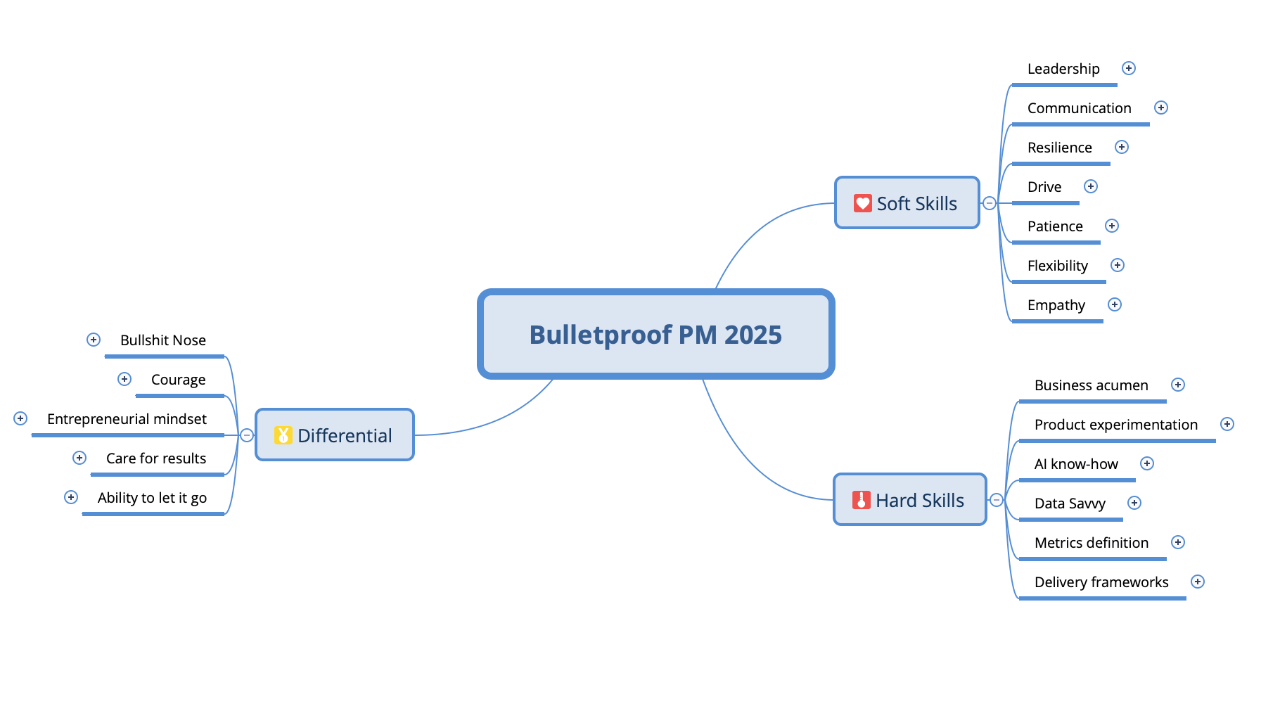
AI is disruptive and will transform our work, especially product managers. Yet specific skills will make you a bulletproof product manager in 2025.
Let’s use this free episode to explore the skills you need to thrive this year.
What’s a Bulletproof Product Manager?
You may wonder what a bulletproof PM is. It’s a professional ready to survive disruptions and become stronger and more attractive in the crowded market.
The bulletproof PM will thrive despite the challenges. Unlike most PMs, this one is ahead of the curve. Principles guide decisions, not frameworks. They focus on driving value no matter what. Their unique skills enable them to move away from bullshit management and create impact.
Let’s explore the skills you need to hone to become the product manager AI won’t replace.
Soft Skills
For a long time, I thought product management was about mastering frameworks, and that’s where I put my energy. Yet I could barely see an improvement in my journey. After years, I recognize that product management is about people and collaboration. Without sound soft skills, you will block your full potential.
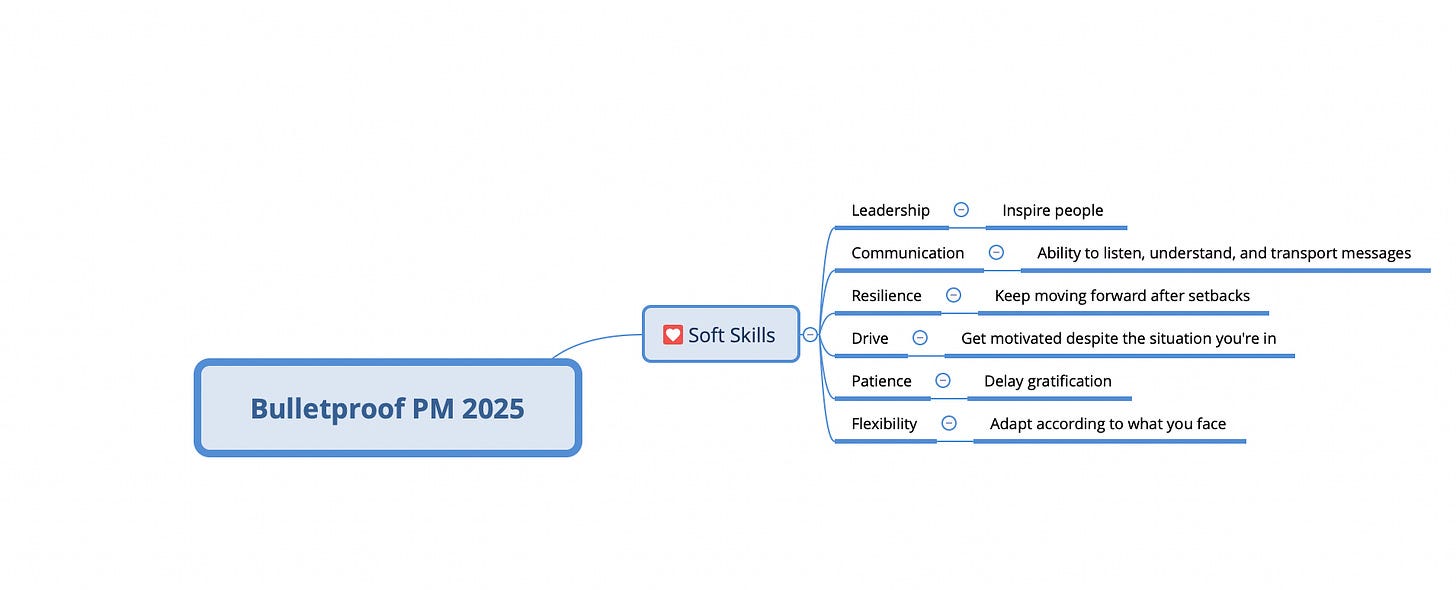
Six skills stand out to me because they pave the way for success.
01 · Leadership
The product manager is an unfortunate name. You don’t manage anyone or anything. Leading is what you indeed do. Yet that’s often misunderstood.
Here are the leadership traits you must pursue to thrive:
- Decision-making: you’re brave enough to make decisions regardless of which information you have. You focus on progressing over analyzing forever.
- Trade-offs: you can quickly analyze trade-offs and choose the best action.
- Inspire: you can get people on a mission to achieve something beyond their imagination.
- Goal setting: you know how vital focus is, so you set one goal at a time and ensure everyone understands why that matters.
- Take action: you act fast. You don’t wait for things to happen; you make them happen. Stepping into the unknown is part of your repertoire.
02 · Communication
As a product manager, you interact with many people, and everyone probably wants something from you. The secret is to filter through the noise to find what’s relevant and move on, which requires solid communication skills.
Communication isn’t only about spreading your message and ensuring people understand what you mean. Beyond that, you also get to understand the others. Here’s what can help you:
- Listen to understand, not to reply: when you talk to someone, notice whether you are thinking about your answer or trying to understand the other person. The first limits knowledge, the latter amplifies it.
- Rephrase to ensure understanding: we often get people wrong. A simple rephrasing of your words can clear up many misunderstandings immediately.
- Choose the right medium: critical feedback lands poorly in a text message but well in a video call or face-to-face conversation. Knowing what to use, when, and with whom is key.
- Talk the language of your audience: an executive wants straight-to-the-point numbers, while a software engineer needs context. Adapt and you connect faster.
03 · Resilience
You will hit the wall more often than you can imagine.
- Users will surprise you.
- Leadership will sometimes reduce investments.
- Software engineers will do things differently than agreed.
- You will eventually receive a roadmap you see no value in.
The above will happen eventually, but resilience keeps you moving forward. Resilience is about sharpening your skin to take punches and keep moving with your head up. Without it, you quickly become demotivated and the work loses purpose. With it, you understand the cards you have and make the best possible move.
04 · Drive
How do you motivate yourself?
When you need external motivational incentives, you depend on others and can quickly become demotivated. External factors cannot be controlled; you can influence them at best. Drive means having an internal motivation mechanism that shows you’re self-sufficient. No matter what’s happening, you’re motivated to keep moving on.
You act as the hero of your story, not the victim of your circumstances.
05 · Patience
Things will take longer than you imagine:
- That cool new feature you validated will take 3x longer than you planned.
- Sharpening something to unleash its potential takes a long time.
- Driving value is slower than shipping features for the sake of it.
The ability to delay gratification is fundamental to thrive. You do now what’s relevant for tomorrow, even when you know you cannot collect any immediate value. For example, saying yes to all stakeholder requests makes you look good in the short term, but it will hit you hard sooner or later. When you say no, you allow your team to focus on what truly matters. Be patient. That will help you grow.
06 · Flexibility
What worked yesterday may not work today. Some product managers learn a few frameworks and want to deploy them wherever they work. However, context matters: some frameworks thrive in startups and fail in big corporations.
Developing a toolbox and a sharp understanding of what to use, when, and how is essential. Product is nothing like a science. It’s more like an art. Flexibility helps you focus on what matters instead of getting distracted by what doesn’t.
Hard Skills
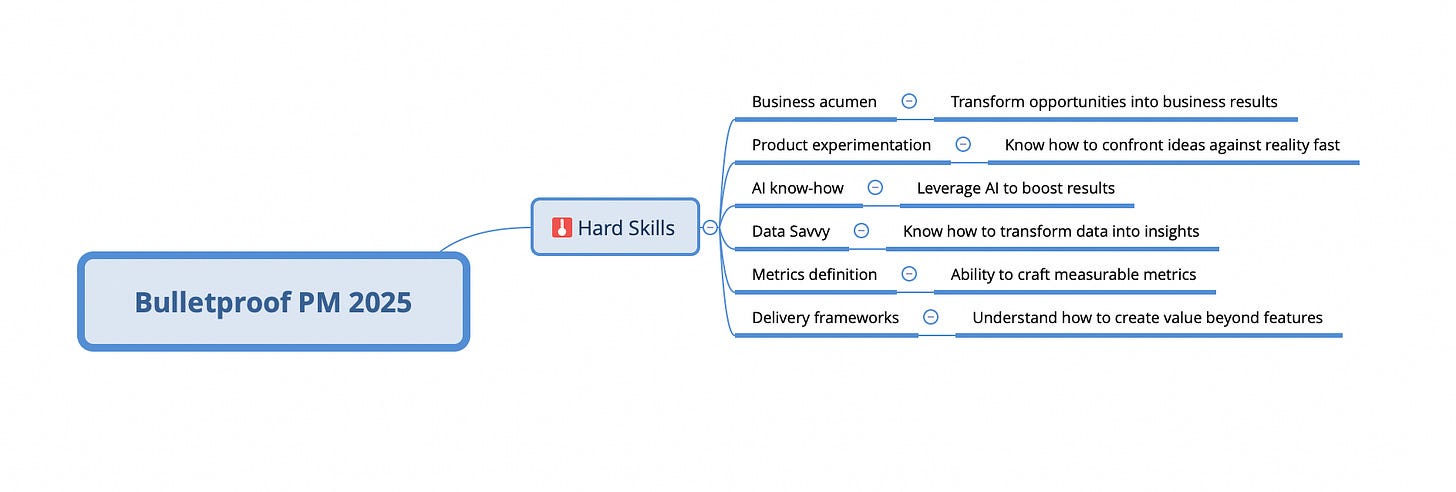
Soft skills pave the way for success, but they aren’t enough alone. You still need a few hard skills to help you thrive. Six will prepare you to deal with the adversities of the product world.
01 · Business Acumen
Product managers need to master business understanding. Here’s what you need to know about your product:
- Business model: how the overall business dynamics work.
- Competition landscape: who your main competitors are, and how you differentiate.
- Revenue model: how your product generates revenue.
- Health: how sustainable your product is financially. Understand it well to uncover opportunities.
- Current challenges: where the struggles are, be it acquisition, activation, monetization, growth, or retention.
Often, product managers serve the business instead of partnering with it. Both need to collaborate so everyone wins. If you lack business understanding, stakeholders will define what to do and you will become a backlog manager at best.
02 · Product Experimentation
Most ideas will generate mediocre to no results. You had better drop the bad ones fast enough, and product experiments are what let you ditch flawed ideas quickly. Sadly, too many product managers use, and abuse, a few test methods. A/B testing isn’t the only method you have. There are many more.
I recommend reading Testing Business Ideas by David J. Bland to amplify your toolbox. The mindset should be: the weaker the evidence, the quicker the experiment.
- First, experiments should run in hours to give you direction: surveys, 404 tests, polls.
- Then you scale to a few days to explore more: landing pages, interactive prototypes, painted doors.
- Ultimately you use more robust experiments to test value creation: Wizard of Oz, concierge, hack a solution.
The more complex your idea, the more experiments you should run. Yet if coding your idea is faster than experimenting, you can deliver the feature to a small portion of your audience and learn from the results. Ensure evidence talks louder than opinions.
03 · AI Know-How
AI is your co-pilot to amplify your potential. However, you remain the pilot. You need to know where you’re going, and AI will help you get there faster. I’ve reflected on what AI can do for product people, and came up with the following.
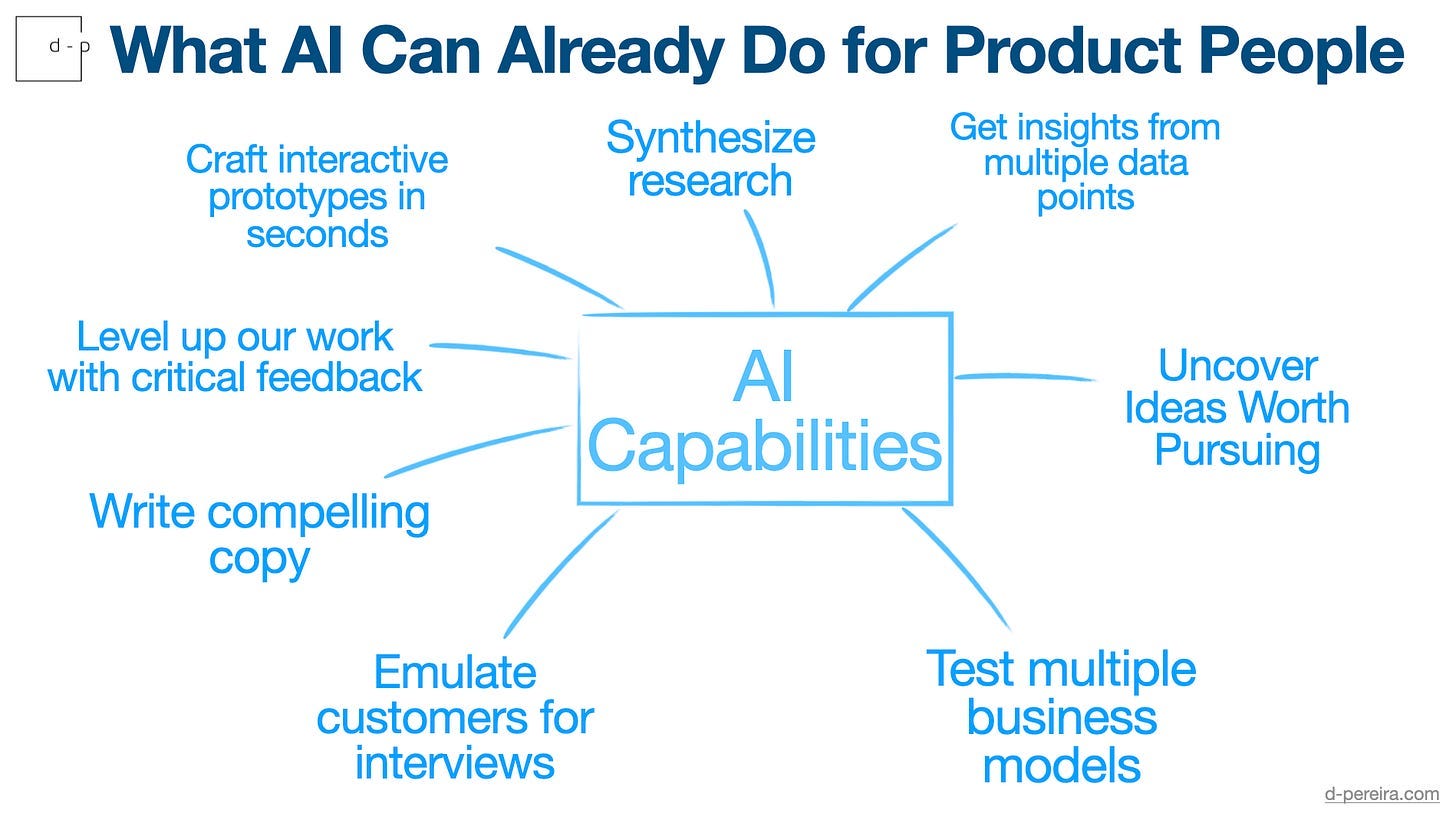
I won’t go through it all here, but I leave a message for you: AI is here to stay and transform how you work. You can either ignore it and become outdated, or leverage it and thrive.
04 · Data Savvy
Understanding how to get insights from data is fundamental, but it goes beyond building dashboards and tracking everything.
- North Star metric: the one thing that defines ultimate success for your product. Airbnb has nights booked per day; Uber, rides per day.
- Leading metrics: the ones you can measure quickly and act on, unlike a laggard metric such as revenue, which takes too long to move.
- Focus: you will have more data than you can imagine. Focusing on what truly matters is fundamental to progress.
Some habits will hurt you, so be careful: tracking everything to decide later, checking data several times a day as if day trading, panicking at every deviation, and sending reports to everyone around you. Data-savvy product managers know how to collect actionable insights from data.
05 · Metrics Definition
What’s success? Defining metrics is fundamental to enabling focus. The most crucial part is knowing which metrics you’re optimizing and which you’re protecting. Even today, many teams ship and forget. That isn’t product management at all. Your job is only done once you drive customer and business value, and you can only evaluate your success if you know how to set measurable metrics.
06 · Delivery Frameworks
I left delivery frameworks for last because they generally become the only thing. You will work with Scrum, Kanban, Scrumban, LeSS, and you should understand how to benefit most from them. Yet frameworks are means to an end, not the end. Your goal remains the same: drive value for customers and the business.
Often I stumble upon misleading questions: how do we do discovery with Scrum? How do we integrate experiments with Kanban? How do we use the Sprint Review to measure outcomes? You’ve got to do discovery, and it doesn’t matter what Scrum says or doesn’t say. The objective isn’t to do Scrum better but to deliver value faster. Don’t let framework definitions limit you. Focus on the job you need to get done.
Differential
Product management is highly competitive yet exciting. I often reflect on what separates the best from the rest, and want to share that with you.
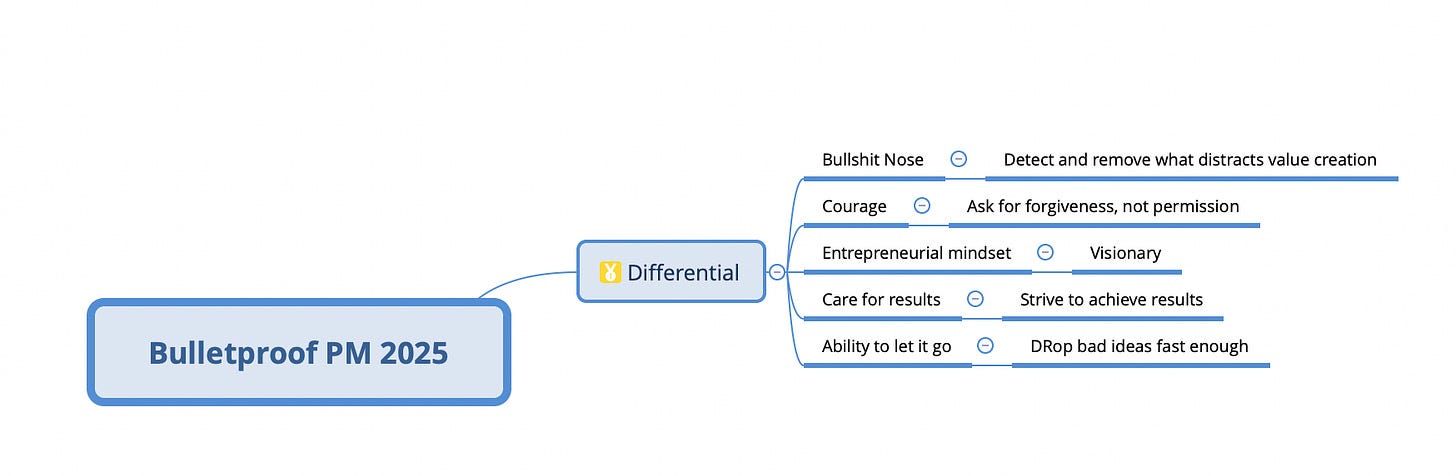
01 · Bullshit Nose
Almost everything is noise, but not everyone notices it. A nose for bullshit is fundamental to unlock teams, boost value creation, and avoid waste. In short, if you don’t know how what you’re doing creates value, it’s probably bullshit. A few examples:
- Feature plans distract teams from creating impact.
- Stakeholder management turns you into a stakeholder puppet; it’s better to build alignment.
- Deadlines are often arbitrary and created out of thin air.
- Meeting marathons breed more meetings; many things can be solved asynchronously or ignored.
The bullshit nose is what it takes to sense something is wrong, stop, and do what makes sense. You don’t let anyone, including yourself, derail from value creation.
02 · Courage
Courage is the number one skill to be a bulletproof product manager. Why? Because you’ve got to have the guts to act when almost everyone is following the flow. One obvious fact is often ignored: you cannot achieve what only a few people reach by doing what most people do. You have to be different.
- Most people keep outdated backlog items instead of deleting them.
- Most people argue about implementing frameworks correctly instead of figuring out what their situation needs.
- Most people focus on roles and responsibilities instead of doing whatever it takes to get the job done.
- Most people say “yes” to avoid conflict instead of saying “no” to stay focused on goals.
- Most people limit themselves to the status quo instead of stepping back to reflect on what works and what doesn’t.
If you want to be a bulletproof product manager, you cannot act like most people. You’ve got to have the courage to step out of your comfort zone. It’s about being comfortable with the uncomfortable.
03 · Entrepreneurial Mindset
Everything is business.
Your job isn’t to make the feature better for the user. Your job isn’t to identify customers’ pain points.
Your job is to uncover opportunities to create successful products, improve customers’ lives, and collect business value. You can only get your job done when you become an entrepreneur. As an entrepreneur, you:
- Continuously assess the risk and reward ratio.
- Strive to uncover angles nobody is looking at.
- Quickly evaluate multiple business models for the same idea.
- Explore hundreds of angles on how to drive and collect value.
- Define experiments you can run now to test if your idea is worth any time.
04 · Care for Results
Many questions don’t matter, but people keep asking: When’s the feature ready? What’s the team velocity? Can you add it to the backlog? How long does it take? You’ll hear these almost daily, and none of them will help you uncover what drives value.
Better questions: How is the last thing we delivered creating value? How can we accelerate value creation? What are the most promising opportunities we should pursue now? What’s the investment-to-value ratio of the idea in question? Everything you do should relate to outcome creation. If you don’t care for results, nobody will, and you will fall prey to the backlog manager anti-pattern.
05 · Ability to Let It Go
Some things won’t work. Sometimes you will wish you had never started a challenge. Many times you will get frustrated with people. All of that is part of the game. What matters is having the courage to let things go:
- You don’t make a bad investment good by pouring more energy into it. Let it go.
- Some things will fail to meet your expected results. Let them go.
- Conflicts with people will happen, but you need a sustainable relationship to create valuable products. Leave problems in the past and move on.
Don’t let the past hold you back from a brighter future. Learn from the past, and act today for a better tomorrow.